What Does the Bible Say About the Presence of God?
Not a Feeling, but a Person
God’s presence is not a feeling to measure, but a reality to receive—God Himself, given to us in Jesus Christ, and made known by His Word and Spirit.
Someone leaves a Sunday service encouraged and says, “God really showed up.” Someone else leaves the same service heavy and quietly wonders, “What’s wrong with me?” Our assumption is that presence must mean a certain kind of experience. If I feel warmed, steadied, lifted—God is near. If I feel numb, distracted, depressed—He must be far. This can turn our prayer life into a search for a sensation, our worship into a test of atmosphere, and our suffering into a verdict: “If God loved me, I wouldn’t feel this alone.” God’s “presence” becomes a product to pursue or a panic to manage. Some chase it. Some fake it. Some give up.
If we can learn to speak about His presence the way Scripture does, then the Christian life stops being a scavenger hunt for emotional proof and becomes what it truly is: fellowship with the living God—sometimes bright, sometimes dark, always real.
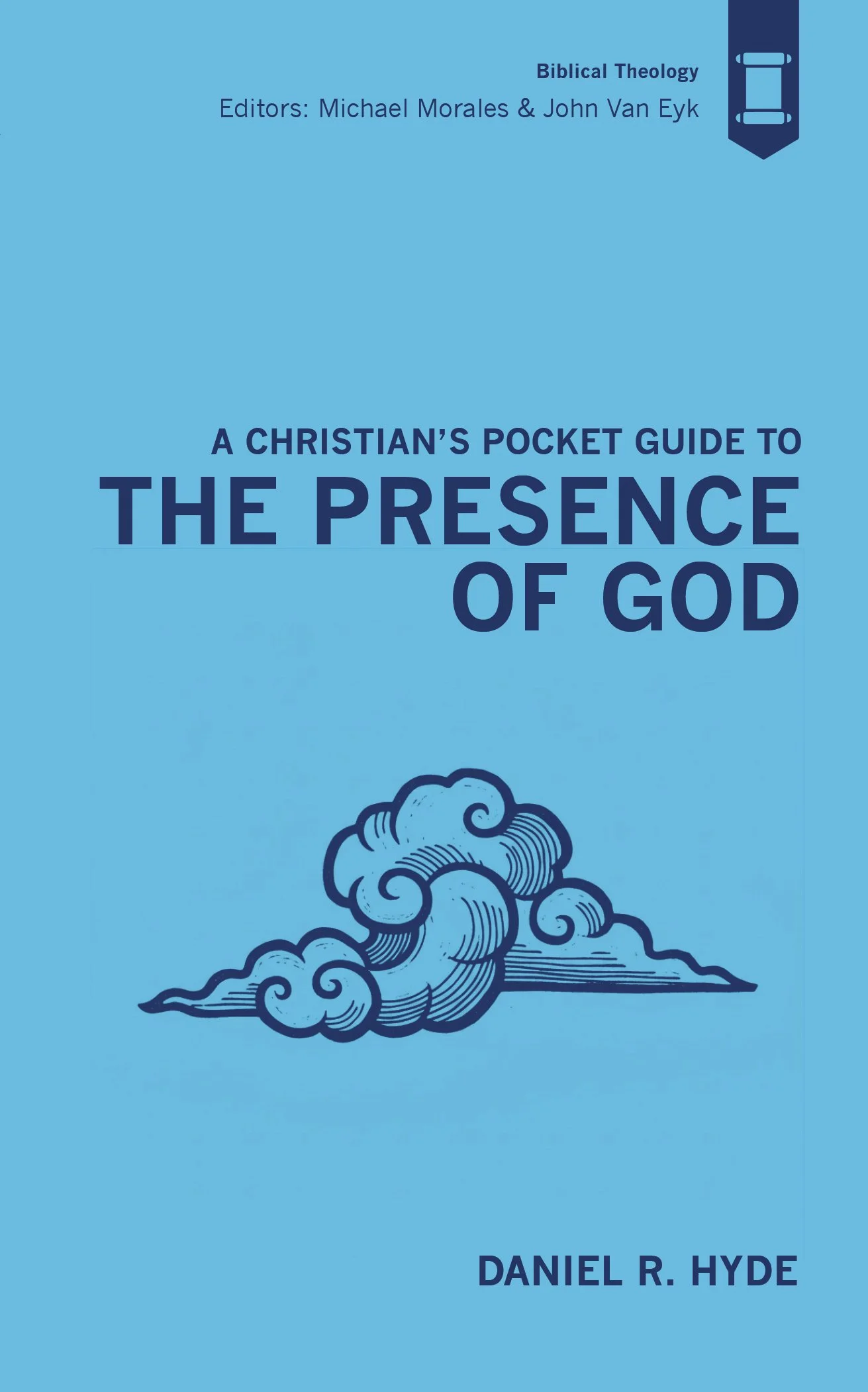
A Christian’s Pocket Guide to the Presence of God (Christian Focus, 2026)
This book is a map—not to a place, but to a person: Jesus Christ. The book’s twelve chapters walk the whole route: creation and the Garden, the Flood, the patriarchs, Egypt and the exodus, the wilderness, the tabernacle, the temple, exile, and then Christ. From Christ it keeps going, into the Christian, the church, and the new creation. A Christian’s Pocket Guide to the Presence of God is short enough for a weekend and written to be read with an open Bible.
The Lord’s people long for his presence. But sometimes we get confused about what that really means. In this brief, but wonderfully biblical book, Daniel Hyde will guide you through what the whole of the Scriptures tell us about the presence of God. This presence isn’t about mere feelings, but glorious reality. For, as Dr. Hyde shows us, from Eden to the New Jerusalem, when we speak about God’s presence, we’re speaking about God himself.
—Jonathan Black, Principal, The Apostolic Church Theology School; Director of Training, The Apostolic Church UK
Many prayer meetings I’ve attended over the past twenty-five years have included someone crying out for God to “usher us into [His] presence.” That longing is holy and sincere, yet it often lacks the depth that Scripture gives to this vital theme. In this concise and thoughtful book, Danny Hyde shows that God’s presence is not something to be worked up or pulled down, but graciously given and faithfully enjoyed in Christ and among His people.
—Mike Neglia, Lead Pastor, Calvary Cork, Cork, Ireland; Host, The Expositor’s Collective, and the buy links carried over from the old post.
Christian Focus (paperback; ebook) | Amazon (paperback; Kindle)
What Is the Presence of God?
When we speak of God’s presence, we’re speaking of God Himself.
When we talk about the “presence of God” as God’s children, we’re not talking about some thing that’s like a magic rabbit’s foot or a force or power we can get. When we speak of “encountering the presence” or “being filled with the presence,” that sounds like an experience with an impersonal thing.
The presence of God is actually the opposite. Through the promises of Christ and the ministry of the Holy Spirit, God Himself invited us into a relationship. His “presence” is wherever He is, particularly for us, His children, in grace. It’s His way of graciously relating to us.
Moses discovered he and Israel couldn’t carry God’s presence around like cargo. Instead, he received a promise: “My presence will go with you, and I will give you rest” (Exod. 33:14). My and I, not an it.
The Old Testament Scriptures speak of God’s “presence.” The common Hebrew term is often translated as “face.” When God reveals His “face,” He brings someone into a close, personal encounter with Himself.
When God speaks, He is near. And in Jesus Christ, God’s nearness has a face.
Further reading: Christian Focus Substack · Aquila Report (once published) — Listen: Pilgrim Radio
If God Is Everywhere, What Is His “Manifest Presence”?
God is omnipresent with all things as God, but He’s particularly present with His people in grace. [Book, Intro, p. xii]
Gregory the Great (540–604) distinguished ways we speak of God’s presence: “God by a common mode is in all things by His presence, power and substance; still He is said to be present more familiarly in some by grace.”[1] The medieval theologian, Peter Lombard (1096–1160) also distinguished two senses in which we can speak of God’s presence: “He does not dwell everywhere that he is; but where he dwells, he is.”[2] God is everywhere; He is omnipresent generally. He also dwells in a particular way with His people. [Book, Intro, pp. xii–xiii]
God’s presence is also manifested in special ways, in special places, and to particular people in grace throughout Scripture’s story. In other words, God is specially or graciously present in making Himself known to His people in ways He doesn’t to all people. [Book, Intro, p. xv]
Adam and Eve knew all about God’s presence, but they hid from Him in fear (Gen. 3:8). Isaiah knew all about the Lord’s presence, which drove him to confess his uncleanness (Isa. 6:5). The presence is law or bad news apart from Christ. Only in Him is it the good news of the gospel for us. [Book, Intro, p. xviii]
The English Puritan pastor, Stephen Charnock (1628–80), followed this simple distinction in terms of God’s essential and gracious presence: [Book, Intro, pp. xii–xiii]
Let the essential presence of God be the ground of our awe, and his gracious influential presence the object of our desire. . . . his essential presence maintains our beings, but his gracious presence confers and continues a happiness.[3]
Further reading: Greystone · Gentle Reformation · Biblical Church Growth
Notes
Gregory the Great, Hom. viii in Ezech., as cited in Thomas Aquinas, Summa Theologica, trans. Fathers of the English Dominican Province (1948; repr., Benziger Brothers, 1981), I, q. 8, art. 3.
Peter Lombard, The Sentences: Book 1, The Mystery of the Trinity, trans. Giulio Silano, Mediaeval Sources in Translation 42 (Pontifical Institute of Mediaeval Studies, 2007), Distinction XXXVII, chapter 2.
Stephen Charnock, “The Omnipresence of God,” in Several Discourses upon the Existence and Attributes of God(1682), 270–71.