The Thirty-Nine Articles and the Belgic Confession: A Review Article
A response to an Anglican comparison of the Thirty-Nine Articles and the Belgic Confession, arguing that its central claims rest on reading theological significance into the order of the Belgic’s articles and on an unstated “Calvin versus the Calvinists” framework. He counters that the Belgic follows the Trinitarian shape of the Nicene Creed, that its placement of election is pedagogical rather than substantive, and that the Reformed churches of the Continent understood themselves as catholic rather than innovative.
Written as a review article in The North American Anglican, this piece engages John P. Boonzaaijer's "Restoration vs. Innovation: Comparing the Thirty-Nine Articles and the Belgic Confession" (Winter 2008). It frames the exchange within the cosmopolitan spirit of the sixteenth century, when Reformed catechisms, confessions, and liturgies were treated as expressions of an international movement rather than the property of any one church—illustrated by Beza's Harmonia Confessionum (1581), its Cambridge translation (1586), and Cranmer's letter to Calvin proposing a Protestant council to answer Trent.
It commends three things in Boonzaaijer's article: its attention to the biography of Guido de Brès and the confession’s own theological and social milieu, its careful treatment of the text and internal structure of the Belgic, and its irenic, bridge-building posture.
The critique falls under three heads. First, Boonzaaijer imputes meaning to the sequence of the Belgic’s articles. It shows that the God-then-Scripture-then-Trinity ordering predates the Belgic across a dozen Reformed confessions from the Tetrapolitan (1530) to the Second Helvetic, that describing the Belgic as “systematic theology” is anachronistic, and that its actual architecture tracks the Nicene Creed. On baptism, he answers the charge that the Reformed reduced it to infant dedication by appealing to Belgic articles 33–34 and to the Dutch Reformed Form for Infant Baptism with Luther’s Great Flood Prayer. On election, he draws on Richard Muller to argue that placement in Reformed dogmatics was a matter of genre and docendi via, not substance.
Second, the article identifies an undertone of R. T. Kendall's discredited “Calvin versus the Calvinists” thesis, noting that the Belgic already confesses an infralapsarian double predestination in harmony with the Canons of Dort, and reminding Anglican readers that Dort was the one truly ecumenical Reformed synod—with the British delegation seated at its head and Joseph Hall preaching the opening sermon on Romans 9.
Third, it argues that the “continuity versus innovation” framing is a polemical Anglican claim rather than a historical one, since the Reformers from Knox to Vermigli to de Brès consistently asserted that they were rejoining the ancient catholic church rather than founding a new one.
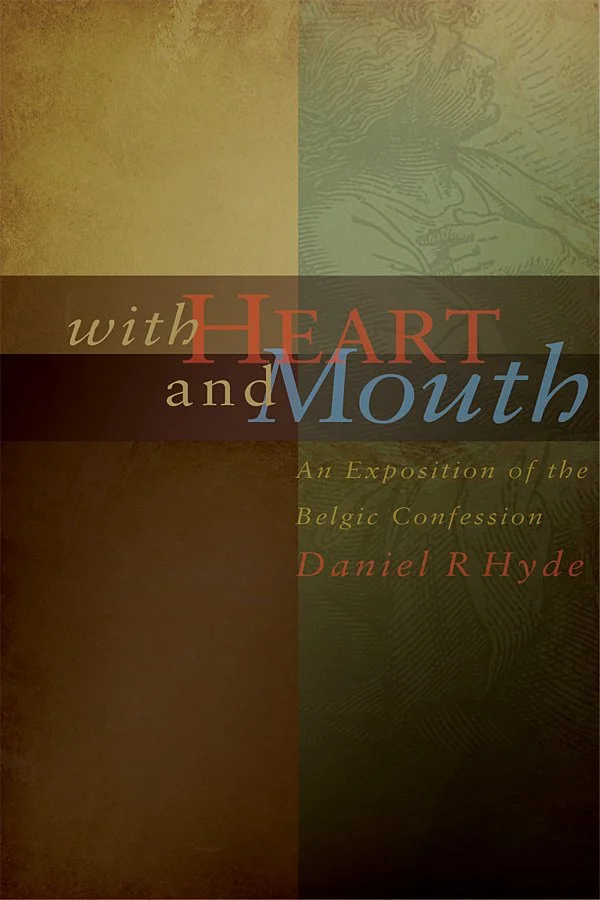
On the Belgic Confession, see: