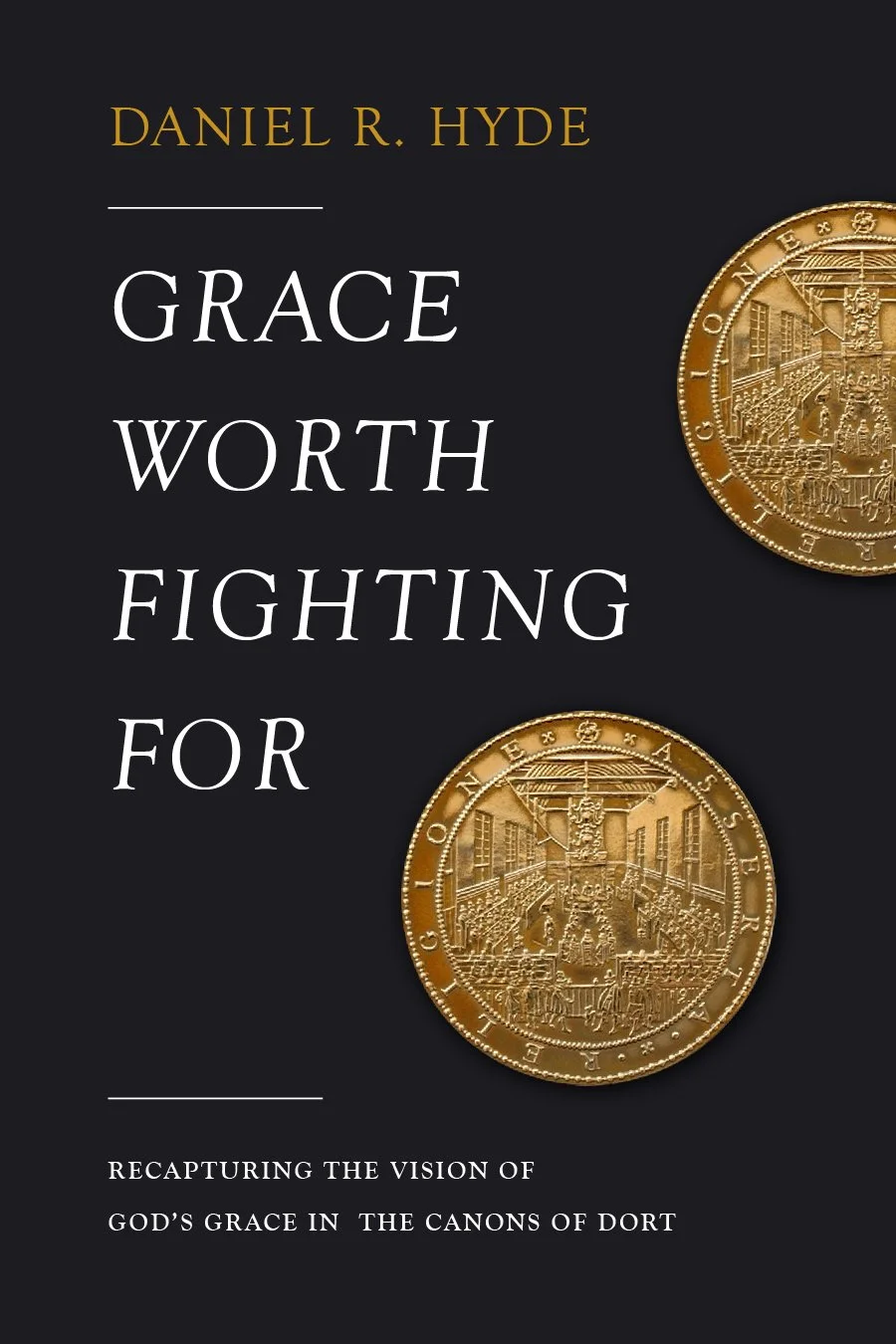
Grace Worth Fighting For
Recapturing the Vision of God’s Grace in the Canons of Dort
If it’s remembered at all, the Synod of Dort is a monument to Calvinist infighting. Written for the Synod’s 400th anniversary, this commentary walks pastors and congregations through all ninety-three articles and rejections to recover what the fight was actually for: the catholic confession of God’s amazing grace to sinners just like you and me.
Grace Worth Fighting For is Daniel R. Hyde’s article-by-article commentary on the Canons of Dort (Davenant Press, 2019; 437 pages). It carefully walks through all ninety-three articles and rejections of errors: what the Synod confessed and what it refuted. It is not another primer on the five points of TULIP. It is a pastoral reading of the Canons themselves for what they confess, what they reject, and why they still offer pastoral counsel to the church. And it is written in a way that pastors, study groups, and congregations can recover Dort for themselves as a catholic confession of God’s grace.
Why I Wrote This Book
I don’t precisely recall the first time I encountered the Canons of Dort, but what I do know is that ever since they’ve been fascinating to me. Over the course of decades, I’ve read what I could when I could on them, researching their history and theology to equip myself to teach and even preach occasionally their doctrines. What I’ve discovered in them has been a surprise: not insular arguments, but a catholic doctrine of God’s amazing grace.
There is increasingly a wealth of English material in print on the Belgic Confession, the Heidelberg Catechism, and the Westminster Standards. On the Canons there is scant material. Having written a commentary on the Belgic Confession of Faith, I desired to do something similar for the Canons. So knowing the four hundredth anniversary year of 2018–2019 was on the horizon, I began consolidating notes. Four hundredth anniversaries don’t occur often for those of us whose “span” is but “seventy or even by reason of strength eighty” (Ps. 90:10).
We sing hymns about grace: “Amazing grace, how sweet the sound, that saved a wretch like me.” Nowadays it’s a cottage industry to talk about “gospel-centered” everything related to Christianity, but do we know what we’re singing when “grace” leaves our lips? Our Reformation forefathers at Dort did.
Since God’s grace proclaimed in the Word of God is always under assault, it’s important to go back to the theological and spiritual battle that led to the Synod. The only cure for our “chronological snobbery,” as C. S. Lewis described, is to engage history.
Grace was worth fighting for back then; it still is!
How This Differs from TULIP Books
TULIP is an early 20th century English acronym. It can still teach people something true; but it’s not the Canons of Dort.
The Canons do not follow that five-letter order, and they do not use some of its most famous words. They put the third and fourth heads together because sin and regeneration belong together. They speak of Christ’s satisfaction, not “limited atonement” as a slogan. The Reformed at Dort disliked the word irresistible for the Spirit’s work. The fifth head is God’s preservation of those he has united to Christ—not a casual “once saved, always saved.” And while predestination is confessed, it is not the center that explains everything else. The Canons begin where Scripture begins: with the God who is revealed, not with a hidden decree.
This book follows that document rather than the acronym. It traces all ninety-three articles: what the Synod confessed and what it rejected. That is why it is longer than a five-points booklet, and why it keeps drifting into preaching and prayer. Dort wrote for churches, not for a debate club. The aim is the same here.
Two further differences matter.
First, the Canons are catholic before they are “Calvinist.” Their predestinarianism is an Augustinian and Reformation retrieval, not a seventeenth-century invention, and their doctrine of God (his eternity, simplicity, and unchangeableness) is doing more work than TULIP posters ever show.
Second, Dort will not let Reformed people hide from God’s revealed love for all, or from the call to preach Christ to all, out of fear of sounding Arminian. Grace that is particular in accomplishment is not cold in proclamation.
If you want the short map of the Canons, including the usual myths, start with The Canons of Dort: A Guide. This book is the article-by-article walk.
“Hyde also busts every myth—and there are a lot!—surrounding Dort.
One of the best features of Hyde’s scholarship is his refusal to detach the doctrines of grace from pastoral ministry and Christian piety.”
MATTHEW BARRETT · CREDO
Contents
Timeline
Introduction: Why Grace Was (and Still Is) Worth Fighting For
Outline of the Canons of Dort
The Grace of Predestination (First Head of Doctrine)
1 What We Confess (Articles 1–18)
2 What We Reject (Rejection of Errors 1–9)
The Grace of Satisfaction (Second Head of Doctrine)
3 What We Confess (Articles 1–9)
4 What We Reject (Rejection of Errors 1–7)
The Grace of Regeneration (Third and Fourth Heads of Doctrine)
5 What We Confess (Articles 1–17)
6 What We Reject (Rejection of Errors 1–9)
The Grace of Preservation (Fifth Head of Doctrine)
7 What We Confess (Articles 1–15)
8 What We Reject (Rejection of Errors 1–9)
Conclusion
Appendix 1: The Remonstrance of 1610
Appendix 2: The Opinions of the Remonstrants (1619)
Bibliography
Where to Buy
Where to Buy
Endorsements
According to Time, “New Calvinism” is one of the top ten religious trends in the world today. But where did original “Calvinism” come from? Danny Hyde provides an expert but accessible tour of the actual conference where these “doctrines of grace” were defined. Hardly a marginal movement, the Synod of Dort was one of the most ecumenical events of the early modern period. Representing not only the Dutch Reformed churches and others in England, Scotland, Germany, Switzerland and France, the conclusions of Dort were even embraced for a brief time by the Greek Orthodox Church. Displaying the continuity of Dort’s teaching with the historic Christian church, Hyde also provides us with a winsome account of its relevance for today.
Michael Horton, J. Gresham Machen Professor of Systematic Theology and Apologetics, Westminster Seminary California
Danny Hyde is an expert guide to the theology of the Synod of Dort. In this fascinating and edifying volume he explores the history and theology of that seventeenth century world so full of genius and grace with his characteristic gusto.
Lee Gatiss, Director of Church Society and editor of NIV Proclamation Bible (Zondervan)
Danny Hyde’s Grace Worth Fighting For may be the most thorough exposition of the Canons of Dort to date. Through careful exegesis and attention to the historical context, he not only explains what these canons mean but why they are biblically grounded and theologically essential. One of the best features of Hyde’s scholarship is his refusal to detach the doctrines of grace from pastoral ministry and Christian piety. A careful reading of the Canons knows that this marriage between theology and doxology is original to Dort, contrary to common caricatures. Hyde also busts every myth—and there are a lot!—surrounding Dort, removing the centuries of stereotypes to present readers with Calvinism in pure form. This book is indispensable for students of Reformed theology and irresistible to its skeptics.
Matthew Barrett, Associate Professor of Christian Theology, Midwestern Baptist Theological Seminary; executive editor of Credo Magazine; author of The Grace of Godliness: An Introduction to Doctrine and Piety in the Canons of Dort
The 400th anniversary of the Synod of Dort (1618-1619) has occasioned a number of articles and books celebrating and detailing how this Synod preserved the Reformation in the Netherlands and produced a remarkable confession on salvation by grace alone. Among these studies of the Synod, Hyde’s is among the best. He provides a lively account of the historical occasion for the convening of the Synod as well as a comprehensive commentary on the points of doctrine that were set forth in its Canons. Contrary to the popular myth that these points represent a peculiar set of Reformed distinctives, Hyde persuasively argues that they represent a catholic consensus set forth by most of the churches of the Reformation. As his title intimates, these doctrines of grace remain a testimony to the gospel of Jesus Christ that is worth recapturing today.
Cornelis Venema, President & Professor of Doctrinal Studies, Mid-America Reformed Seminary, and author of But for the Grace of God: An Exposition of the Canons of Dort
Reviews
Themelios (The Gospel Coalition)
The Standard Bearer (RFPA)
The Irresponsible Reader, here and here.
Goodreads — reader reviews
Interviews and Podcasts
A Plain Answer (Redeemer Broadcasting) - listen
BRIDGE Radio, episode 75 — listen
“Dort and the Dutchifornian Pastor” (Mortification of Spin) — listen
Guilt Grace Gratitude, “The Canons of Dort,” — listen
Iron Sharpens Iron Radio, 17 May 2019 — listen
New Geneva Podcast, 10 November 2019 — listen
The Layman’s Lounge, 2 July 2020 —listen
The True Presbyterian, 12 February 2020 — listen
Theology on the Go (Alliance of Confessing Evangelicals) — listen
The Book Itself
Publication Details
- Full title
- Grace Worth Fighting For: Recapturing the Vision of God’s Grace in the Canons of Dort
- Author
- Daniel R. Hyde
- Publisher
- Davenant Press (The Davenant Institute)
- Published
- March 3, 2019
- Pages
- 437
- ISBN-13
- 978-1-949716-92-4
- ISBN-10
- 1-949716-92-9
- Formats
- Paperback, Kindle, and audiobook
How to Cite This Book
Note
Daniel R. Hyde, Grace Worth Fighting For: Recapturing the Vision of God’s Grace in the Canons of Dort (Davenant Press, 2019), 00.
Bibliography
Hyde, Daniel R. Grace Worth Fighting For: Recapturing the Vision of God’s Grace in the Canons of Dort. Davenant Press, 2019.
Chicago style, 18th edition, which also serves for Turabian. Replace 00 in the note form with your page number.
Related Reading
The Canons of Dort: A Guide — A free introduction to the document itself: the history behind it, what each head of doctrine says, and the misconceptions that still cling to it.
Why I Love the Canons of Dort — A short article of appreciation for the Canons’ doctrine of God’s grace to sinners, catholic way of doing theology, their realism on the Christian life, and why they’re so much more than “TULIP.”
Regulae de Observatione Sabbathi: The Synod of Dort’s (1618–19) Deliverance on the Sabbath— A journal article exploring the Synod of Dort’s six “rules for the observance of the Sabbath,” placing them in their theological, social, and ecclesiastical context, and seeking to demonstrate they were neither lax nor legalistic but a moderately Puritan articulation of the fourth commandment.
Browse all of Daniel R. Hyde's books
Studying the Canons Together
I wrote Grace Worth Fighting For so that it could be used in more than one setting: by pastors preparing to preach, by study group leaders working through a head of doctrine at a time, and by anyone reading for personal edification. Contact Davenant Institute for bulk pricing for churches and study groups.
I also teach this material at academic conferences, officers’ retreats, and congregational-level conferences and seminars. If you’d like to bring the Canons to your church or classis, I'd be glad to hear from you.
© 2026 Daniel R. Hyde. Permission is granted to reprint this page in full, unaltered, for non-commercial use, provided the attribution below is included and links to the original. For excerpts, translations, or commercial use, see Permissions.
To attribute: Daniel R. Hyde, "Grace Worth Fighting For," https://www.danielrhyde.com/grace-worth-fighting-for. Used by permission.