The Canons of Dort: A Guide
The Canons of Dort are the theological rules — canons, from the Greek word for a straight measuring rule — written at an international gathering of Reformed professors, pastors, elders, and statesmen at the Dutch city of Dordrecht in 1618–19. They were written in response to a struggle within the Dutch Reformed Church but also throughout Europe, over the teachings of the pastor-turned-professor Jakob Hermanszoon, whom you know better by his Latinized name: Jacobus Arminius.
They are not the same thing as TULIP. That acronym arrived three centuries later, in another language, and reorders what the Canons actually say. What follows is a guide to the document itself.
What are the Canons of Dort?
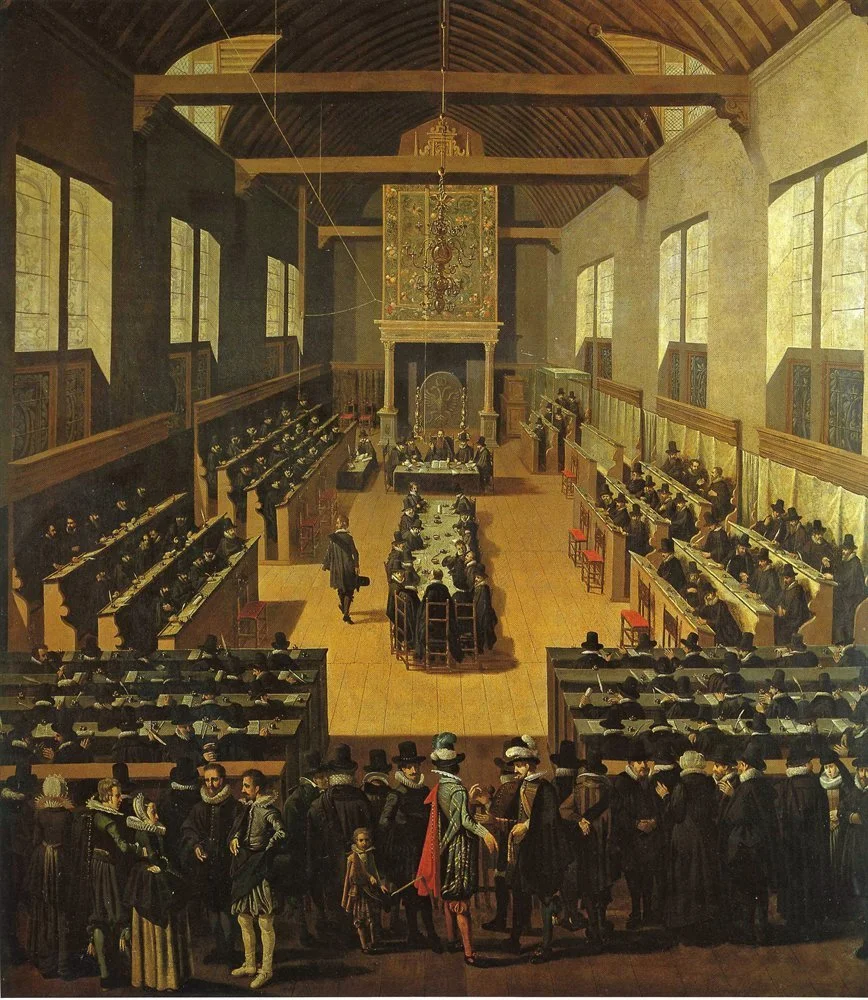
On May 6, 1619, delegated pastors and professors from across Europe processed through the streets of Dordrecht to the Grote Kerk, the “Great Church.” There the Canons of Dort were read publicly in Dutch for the town and its guests to hear. As each delegate’s name was called, he tipped his hat in assent. Ever since, the Canons have belonged to the confessional heritage of the Dutch Reformed churches.
The document is organized into heads of doctrine. Each point, or “head” (caput), contains several positive articles of what is confessed, and then several rejections of errors. Altogether that comes to fifty-nine positive articles of belief plus thirty-four rejections of errors — ninety-three doctrinal points, resting on hundreds of supporting passages of Scripture. This is worth mentioning the next time someone tells you the Canons are dry scholasticism.
Together with the Belgic Confession (1561) and the Heidelberg Catechism (1563), the Canons make up what are called the Three Forms of Unity. After the Synod, a Form of Subscription was adopted for ministers, professors, school teachers, elders, and deacons to swear before God that they believed the doctrine of the Confession, Catechism, and Canons is biblical. The churches I serve still require this.
The Canons of Dort at a glance
- Written
- November 13, 1618 – May 29, 1619, at the National Synod of Dordrecht
- Delegates
- Eighty-four — fifty-eight Dutch and Walloon, twenty-six from Reformed churches abroad
- Structure
- Four heads of doctrine answering five points; the third and fourth were answered together
- Content
- Fifty-nine positive articles and thirty-four rejections of errors — ninety-three points in all
- Standing
- The third of the Three Forms of Unity, with the Belgic Confession (1561) and the Heidelberg Catechism (1563)
Why was the Synod of Dort Called?
The Reformation did not start on October 31, 1517, with Martin Luther, nor did it arrive in the Netherlands on untilled soil. For generations, reforming movements had been calling the church back to the Word. Groups such as the Waldensians and Lollards had fled there, and movements within the Netherlands such as the Brethren of the Common Life encouraged a simple, Scripture-shaped piety. Then came the weight of empire. Under Philip II of Spain, persecution intensified. Tensions boiled over in 1566 in the beeldenstorm, a wave of popular iconoclasm.
At the eye of the storm that followed stood Arminius. Educated at Leiden and then abroad, he had strong Reformed credentials and even a glowing letter of recommendation from his professor at Geneva, Theodore Beza. In 1588 he became a pastor in Amsterdam. Yet as he preached through Romans, concerns began to grow. On Romans 5 he said death was inevitable even if Adam had obeyed the Lord’s command. On Romans 7 he moved away from the Augustinian tradition, suggesting that Paul was speaking of the unregenerate man. Especially on Romans 9, he interpreted “Jacob I loved, but Esau I hated” as classes of people, not individuals.
His colleague Franciscus Gomarus came to believe that Arminius’ theology endangered the church’s doctrine of justification by faith alone. If election was grounded in foreseen faith, then faith itself became the basis of God’s choosing. In other words, faith was a kind of work. Gomarus said he would not dare appear before God’s throne believing what Arminius believed. The issue was no mere academic quarrel. It touched the very question of whether salvation is wholly of grace.
Arminius died in 1609, remembered even by opponents as a humble and godly man, but the controversy did not die with him. In January 1610, forty-three ministers sympathetic to him met in Gouda and issued a five-point document called the Remonstrance, a public protest. From that point on they were known as the Remonstrants. Their opponents replied in 1611 with a Counter-Remonstrance. The conflict spread from lecture halls and consistories into the pews and the streets. Congregations divided. Worshipers moved from church to church to avoid certain preachers. Riots broke out. As the Leiden philosopher Petrus Cunaeus observed, theologians had introduced this strife into the social media platforms of their day: barbershops, boats, wagons, and theaters. Through 1617–18 the Dutch Republic itself was nearing civil conflict, while the threat of renewed war with Spain loomed.
By the summer of 1617, Prince Maurice had aligned himself with the strict Calvinist party by worshiping with them in The Hague. It’s reported that up to this point Maurice said he didn’t know whether predestination was blue or green, but that he was going to make it orange—the color of his own House of Orange. In response, Johan van Oldenbarnevelt rallied two provinces to declare that no national synod would be held, and had local magistrates raise militias to prevent one. But Maurice proved it’s better to speak softly and carry a big stick. Unlike Oldenbarnevelt, he had a standing army, and it disarmed those militias in July 1618.
Under that pressure, the States General finally called a national synod.
Who was Actually at the Synod of Dort?
At the urging of King James I of England, what began as a national synod became an international one. Reformed churches from across Europe were invited to send delegates so that the Dutch churches would not settle this matter in isolation. Invitations went to England, France, Brandenburg, the Palatinate, Hesse, Nassau-Wetterau, Bremen, Emden, Geneva, and several Swiss cantons.
The Synod hosted eighty-four delegates: fifty-eight theologi interi, Dutch and Walloon, and twenty-six theologi exteri, international. They met in the retrofitted Kloveniersdoelen, the musketeers’ shooting range. Perhaps the irony didn’t escape them.
King James sent the Synod’s only bishop, George Carleton of Llandaff in Wales, referred to in the notes of the Synod merely as “the Bishop.” Geneva sent Giovanni Diodati, pastor and successor to Beza. From Hesse came the eldest member of the Synod, the seventy-one-year-old Rudolph Goclenius. The French were forbidden by King Louis XIII from attending, and Brandenburg stayed away for fear of damaging its relationship with surrounding Lutheran princes. In honor of the French, an empty set of benches stood alongside the British.
This was no small provincial meeting. It was, as one observer put it, a muster of the forces of Calvinism.
Why are There Five Points But Only Four Heads of Doctrine?
The Canons are structured according to the five points of the Remonstrance of 1610: predestination, satisfaction, corruption, conversion, and preservation. In response to each point the Synod didn’t merely write one counter-point; instead, each became a “head” (caput) or main point of doctrine.
But there are four heads, not five. The third and fourth points of the Remonstrance—human corruption, and God’s grace in conversion—were answered together in a single combined head, which is why articles from that portion are cited as “3/4.”
The Synod treated them together because the Remonstrants’ original third point on the corruption of human nature was unobjectionable in itself, though by the time the Synod met they had written a good deal more that gave cause for concern. And since corruption and the grace that overcomes it form one continuous argument, the two were merged: what the third point describes, the fourth answers.
Five points, four heads of doctrine
| The Remonstrance of 1610 | The Canons of Dort, 1618–19 | Length |
|---|---|---|
| Article 1 “…God…determined before the foundation of the world to save…those…who by the grace of the Holy Spirit shall believe in this his Son…and persevere…to the end…” | First Head — Redemption Planned “Before the foundation of the world, by sheer grace, according to the free good pleasure of his will, he chose in Christ to salvation a definite number of particular people out of the entire human race…he decided to grant them true faith in Christ, to justify them, to sanctify them, and finally…to glorify them.” (1.7) | 18 articles 9 rejections |
| Article 2 “…the Savior of the world died for all men and for every man…yet so that no one actually enjoys this forgiveness of sins except the believer.” | Second Head — Redemption Accomplished “…it was God’s will that Christ through the blood of the cross…should effectively redeem from every people, tribe, nation, and language all those and only those who were chosen from eternity to salvation and given to him by the Father…[to] grant them faith (which…he acquired for them by his death)…” (2.8) | 9 articles 7 rejections |
| Article 3 “…man does not have saving faith of himself nor by the power of his own free will, since he in the state of…sin can not of and through himself think, will or do any good…especially saving faith, but that it is necessary that he be regenerated by God…” | Third and Fourth Heads — Redemption Applied Answered together in one head. “All people are conceived in sin and are born children of wrath, unfit for any saving good, inclined to evil, dead in their sins, and slaves to sin; without the grace of the regenerating Holy Spirit they are neither willing nor able to return to God…” (3/4.3) | 17 articles 9 rejections |
| Article 4 “…regenerate man cannot, apart from…grace, think, will or do the good or resist any temptations to evil…all good works…must be ascribed to the grace of God…But with respect to the mode of this grace, it is not irresistible…” | ||
| Article 5 “…those…have abundant strength to strive…through the assistance of the grace of the Holy Spirit…But whether they can through negligence fall away from…life in Christ…must first be more carefully determined from the Holy Scriptures before we shall be able to teach this with the full persuasion of our heart.” | Fifth Head — Redemption Preserved “Because of these remnants of sin dwelling in them and also because of the temptations of the world and Satan, those who have been converted could not remain standing in this grace if left to their own resources. But God is faithful, mercifully strengthening them in the grace once conferred on them and powerfully preserving them in it to the end.” (5.3) | 15 articles 9 rejections |
Five Remonstrant articles, four heads of doctrine: the third and fourth were answered together. Fifty-nine positive articles and thirty-four rejections of errors — ninety-three points in all. Canons of Dort quoted from threeforms.org, © 2026 URCNA.
Are the Canons of Dort the Same as TULIP?
No. Am I allowed to say there is no such thing as the five points of Calvinism? I just did!
TULIP is the acronym for Total depravity, Unconditional election, Limited atonement, Irresistible grace, and Perseverance (or, Preservation) of the saints. It’s supposedly what the Synod of Dort decided contra the Arminians. But the acronym is a twentieth-century invention. It has been traced to a 1905 address by a Dr. McAfee of Brooklyn, delivered to the Presbyterian Union of Newark, New Jersey. It reorders the actual points of both the Remonstrants and the response in the Canons; their own sequence would give you something more like ULTIP. And it would have been impossible to come up with in the seventeenth-century Netherlands, since the Dutch word for tulip is tulp. I guess the phrase “limited atonement” is limited after all.
Modern terminology oversimplifies historical complexities. If I could travel back just before the Synod to the Dutch city of Heusden and ask its new pastor and future delegate, Gijsbertus Voetius, “Domine Voetius, what does it mean to be Reformed?” he might have said: “To believe the thirty-seven articles of the Belgic Confession and the one hundred twenty-nine questions and answers of the Heidelberg Catechism, of course!” That is 166 points of theology before Dort ever met. Add the Canons’ ninety-three articles and rejections and you have 259-point Calvinism. And we think being a five-pointer is really flexing some theological muscle.
Richard Muller has put it plainly: there are more than five points, and there cannot be such a thing as a five-point Calvinist who owns those five articles and refuses the rest. I’ve made the case at length in Grace Worth Fighting For, and more briefly in why I love these Canons after twenty-five years of reading them.
But there is a second problem with the acronym, and it runs deeper than the arithmetic. Each of its five letters also misdescribes the doctrine it is meant to summarize. Those five misunderstandings are common enough, and consequential enough, that this guide takes them one at a time below.
Were the Canons Reformed Distinctives or Catholic?
The Canons make a striking claim about themselves at the end of the fifth point of doctrine, article 15: “The bride of Christ, on the other hand, has always loved this teaching very tenderly and defended it steadfastly as a priceless treasure.” Always invites the question: are the Canons catholic?
The men at Dort thought so, and they aimed at it deliberately. In March 1619, Samuel Ward of the British delegation asked King James to press the Synod to have a special eye to the definitions of the ancient councils against the Pelagians. The King agreed. His secretary of state wrote to the ambassador that the conclusions against the Remonstrants should be couched as near as possible to the forms used in the primitive church by the fathers of that time against the Pelagians and Semi-Pelagians, and not in any new phrases of the modern age. The Palatinate delegates advised the same: form the response as the ancient councils had, in brief and vigorous canons.
They followed through. Pelagius, Pelagian, and Pelagianism appear eight times across the Canons. One rejected view is described as savoring of Pelagius (Pelagium enim sapiunt); in our parlance, if it walks like a duck and quacks like a duck, it’s a duck. Another summons back from hell the Pelagian error. A third is called the deadly poison of Pelagianism.
The delegates’ own working papers say the same thing more quietly. Donald Sinnema counted 119 references to theological sources across the various iudicia: sixty-five to Augustine, thirty-seven to other patristic writers such as Prosper, eleven to medieval sources. All the while, only six reference Reformation and post-Reformation authors.
Far from being a Reformed distinctive, the doctrine of sin and grace at Dort is a faithful appropriation of ancient Augustinian catholicity as expressed at the Second Council of Orange in 529. This is what the Reformed church has always understood itself to be: not a new thing, but an old one recovered.
What Does Each Head of Doctrine Teach?
The Canons unfold in four movements: redemption planned, accomplished, applied, and preserved.
Redemption Planned — First Head: 18 articles, 9 rejections
The first point opens not with predestination but with our sin and condemnation, God’s love in Christ, and God’s mercy in preaching. Election is defined only in article 7, with our salvation as its subordinate end and God’s own glory as its ultimate one. 1.9 denies there are prerequisites in us that cause election; faith and holiness are its effects. Then come the questions people actually ask: whether assurance is possible (1.12–13) and whether election should be preached at all (1.14). The Westminster divines faced that same question, and I’ve written on how they handled so high a mystery. Reprobation appears only in 1.15, followed at once by two pastoral answers (1.16–17).
Redemption Accomplished — Second Head: 9 articles, 7 rejections
The second point begins with the doctrine of God: he is not only supremely merciful but also supremely just. His justice requires that the sins we have committed against his infinite majesty be punished. We cannot escape unless satisfaction is given. Christ’s death is that satisfaction: the only and entirely complete sacrifice for sins, of infinite value and worth, more than sufficient to atone for the sins of the whole world (2.3). This promise, together with the command to repent and believe, ought to be announced and declared without differentiation or discrimination to all nations and people (2.5). 2.8 is the lengthiest in this head and defines what the Father intended that death to accomplish.
Redemption Applied — Third and Fourth Heads: 17 articles, 9 rejections
These begin with man originally created in the image of God, furnished in his mind with a true and salutary knowledge of his Creator, in his will and heart with righteousness, and in all his emotions with purity. In a word, the whole man was created holy. Rebelling at the devil’s instigation and by his own free will, he deprived himself of these outstanding gifts, and in their place brought upon himself blindness, terrible darkness, futility, and distortion of judgment. A certain light of nature remains, but it is far from enabling man to come to a saving knowledge of God; nor can the law, which exposes the magnitude of his sin but offers no remedy and no escape from his misery. What therefore neither the light of nature nor the law can do, God accomplishes by the power of the Holy Spirit, through the Word.
Redemption Preserved — Fifth Head: 15 articles, 9 rejections
The fifth point opens with two common Christian convictions that frame everything after: we are freed from our slavery to sin, but not from our struggle with sin. Thus, daily sins of weakness arise, and blemishes cling to even the best works of God’s people. Those who have been converted could not remain standing in this grace if left to their own resources. Yet in his faithfulness, God mercifully strengthens his people in the grace he bestowed on them and powerfully preserves them in it to the end. The rest of the head takes up what follows: serious sin, assurance, the means of grace, and consolation.
What are the Rejections of Errors?
Every head follows the same shape. It opens with several articles of common Christian conviction, catholic ground almost anyone would grant (1.1–4; 2.1–7; 3/4.1–2 and 4–5; 5.1–2). Then one article defines the disputed doctrine (1.7; 2.8; 3/4.3 and 6; 5.3). Then the implications are drawn out: God’s justice and the fault of sin, the responsibility of man in salvation, assurance of faith, godliness, and the importance of the means of grace. Only then come the things rejected.
There are thirty-four of them, and they are the least-read part of the document. They shouldn’t be. The rejections are where you discover what was actually at stake, and they are not caricatures. When the Remonstrants were dismissed on January 14, 1619, the States General had already resolved that their doctrines would be judged on the basis of their published writings. A committee drew up a series of theses from those sources. What the rejections quote back is the Remonstrance of 1610, the 1611 conference at The Hague, Episcopius, Barlaeus, and Arminius himself.
Do the Canons Teach that God Only Loves Some People?
This is the objection that comes up most, and the Canons answer it before they ever reach the doctrine of predestination and election.
Watch the order of the opening articles. 1.1 says that God is just. 1.2 says that God is love. 1.3 says that God is merciful and that mercy takes the form of sending preachers, since it is by their ministry that people are called to repentance and faith in Christ crucified. Three articles in, and not a word yet about an eternal decree.
Think of three brothers. All have heard the good news of Jesus. Yet two of the three do not evidence true faith. Many of you are in the same situation with your family, and the question is why. The Canons don’t dodge it. All who are called through the gospel are “called seriously” (serio vocantur; 3/4.8). That phrase was the Remonstrants’ own; the Synod took it up from them. For seriously and most genuinely God makes known in his Word what is pleasing to him: that those who are called should come to him. And where someone doesn’t, the Canons are equally direct about where the fault lies. It must not be blamed on the gospel, nor on Christ, who is offered through the gospel, nor on God, who calls them, but on the people themselves who are called (3/4.9).
The second head is more explicit still. The promise of the gospel, together with the command to repent and believe, must be announced and declared without differentiation or discrimination to all nations and people (2.5).
The Synod knew it would be accused anyway. Its Conclusion lists four slanders then in circulation, the last of which was that in the same manner in which election is the source and cause of faith and good works, reprobation is the cause of unbelief and ungodliness. The response is not a careful qualification. These and very many other slanderous accusations of this kind, the Synod said, the Reformed churches not only disavow but even denounce with their whole heart.
Do the Canons Teach Double Predestination?
It’s popularly said that Reformed theology confesses double predestination. John Piper calls himself a seven-point Calvinist because the five points lead to two further truths, one of them double predestination.
But double predestination is neither distinctly Reformed nor even agreed upon as to what one means by it. Isidore of Seville spoke of gemina praedestinatio and Thomas Bradwardine of duplex praedestinatio. This is a long medieval conversation the Reformed inherited rather than invented. And even Gottschalk, who said God predestines to life and equally (pariter) to death, did not actually treat the two as equal. Donald Sinnema, who has studied the question most closely, says that to speak of the Calvinist view of reprobation in this period is much too imprecise, because there was no single Calvinist position. The delegates at the Synod debated at least six of them.
What they adopted was the late medieval distinction between negative and positive reprobation, developed by Nicholas of Lyra and later popularized by Étienne Brulefer. God’s will is the cause of negative reprobation, or preterition, in which he passes over the non-elect. Human sin is the cause of positive reprobation, or condemnation.
So watch the verbs in 1.15. The non-elect are “passed by” (praeteritos) and “left” (relinquere) in their own ways and under his just judgment. Then, and only then, are they “condemned” and “punished,” not only for their unbelief but also for all their other sins, in order to display God’s justice. God actively chooses some to life apart from their works. He passively leaves others in their sin. Only then does he actively decree the condemnation their sin deserves.
Those are not parallel acts. Dort was saying nothing here that the Belgic Confession had not already said in its sixteenth article, fifty-seven years earlier. And 1.15 ends by insisting that the decision of reprobation does not at all make God the author of sin. This is a blasphemous thought.
The caricature is old. In 1592, a quarter-century before Dort met, the Lutheran Saxon Visitation Articles were already listing among the false and erroneous doctrines of the Calvinists that God created the greater part of mankind for eternal damnation. It wasn’t true then either.
Do the Canons Teach “Limited” Atonement?
The Canons never use the phrase, and neither word in it is really theirs. “Atonement” was William Tyndale’s attempt to popularize the language of propitiation and satisfaction, which is what was actually being debated at Dort. The Synod’s own title for the second head was De Morte Christi et Hominum per eam Redemptione: “concerning the death of Christ and the redemption of humanity through it.” “Limited atonement” has limited usefulness.
It’s unhelpful for a second reason. Thinking in crass quantitative terms makes it sound as though Jesus had only so much blood to spend, gathered as many sinners as it would cover, and then ran out. What the Canons say is that this death of God’s Son is of infinite value and worth, more than sufficient to atone for the sins of the whole world (2.3). “More than sufficient” (abunde sufficiens). Thomas Aquinas said Christ’s one death would suffice were there infinite worlds. William Perkins said the price could redeem a thousand worlds of men. John Owen said that if there were a thousand worlds, the gospel might upon this ground be preached to them all.
Now here is what usually goes unnoticed. Except for consistent universalists, everyone limits the saving efficacy of Christ’s death— even the Remonstrants. Their own second article says “Jesus died for all men and for every man, meriting reconciliation and forgiveness for all,” and then adds: “yet so that no one actually enjoys this forgiveness of sins except the believer.”
We on the Reformed side like to say that Calvinists limit extent while Arminians limit efficacy. I think that’s overly simplified. We both limit the extent of Christ’s death. The difference is that we limit it according to God’s will, while Arminians limit it according to man’s.
Think of a light with no shade. It disperses everywhere. Christ’s death is infinitely sufficient to satisfy the infinite justice of God for a million worlds. Put a cap on it, and all that same light is focused in a particular direction. Call that limited atonement if you must; I will call it Jesus doing exactly what God planned.
Do the Canons Teach “Irresistible” Grace?
The word isn’t from the Canons. It’s from the Remonstrance. The fourth Remonstrant article grants that grace is necessary and then adds the clause that mattered: “but with respect to the mode of this grace, it is not irresistible.” There is poison in the tail, as David Paraeus put it. King James said much the same more diplomatically: the articles were expressed with cunning and art to make a specious show.
Paraeus called the term “horrid and barbarous,” and said our orthodox men do not acknowledge this barbarous and ambiguous word. He had a reason. There is a sense in which the Reformed affirm that grace is resistible. The outward call of the gospel is not irresistible but, in his words, too much resistible. The will before conversion can do nothing but resist it. Scripture says exactly that of people who were stiff-necked, uncircumcised in heart and ears, and always resisting the Holy Spirit.
So what do the Canons say? Just as sin did not deprive Adam of his human nature but brought upon him depravity and spiritual death, so this divine grace of regeneration does not act in people as if they were blocks and stones (3/4.16). The Latin is truncis et stipitibus, “tree trunks and stakes.” Inanimate, lifeless things. We are not saying human beings were mindless zombies that God grabbed hold of and made alive, and we are not saying he bypassed the intellect and will in converting us. Sometimes well-intentioned people say, “I was brought into the kingdom kicking and screaming; that’s irresistible grace.” That is not what the article says.
Grace does not abolish the will and its properties or coerce a reluctant will by force, but spiritually revives, heals, and reforms. In a manner at once pleasing and powerful, grace bends the will back. A will once bent in upon itself is bent outward toward its Maker. 3/4.16 ends by insisting that it is in this that the true and spiritual restoration and freedom of our will consist.
The word to use isn’t irresistible. It’s efficacious.
Do the Canons Teach “Once Saved, Always Saved”?
Do we believe that those God in his love chose in eternity will spend an eternity loving him? Yes. But look at how the slogan gets used. It’s used to say that a person who claims to be a Christian can live like an unbeliever his or her whole life and still be saved. It’s used to justify sin and apathy about godliness. Do we believe once saved, always saved? Not in that familiar sense. But yes, if understood rightly.
Start with two words the slogan collapses. Preservation is God’s act. Perseverance is ours. The fifth head is about both.
It opens by conceding the problem rather than hiding it. God sets us free from the reign and slavery of sin, though in this life not entirely from the flesh and from the body of sin. For this reason, daily sins of weakness arise within us as well as sinful blemishes that cling to even our best works (5.1–2).
Then the distinction everything turns on. A true believer cannot fall from grace, but a true believer can fall into heinous sins. To fall from grace would be to become unsaved and outside the grip of God’s hand. To fall into sin, even heinous sin, is still to be in the grip of grace, albeit not a very tight grip. The Canons name names: witness the sad cases, described in Scripture, of David, Peter, and other saints falling into sins. David, who instead of watching out for sin was watching to sin. We are not describing a lifestyle that lasts a lifetime. We are describing some particular instances.
What the Canons deny is that God permits the destruction of the covenant relationship. He renews it. He is faithful, so He mercifully strengthens his children in the grace He conferred on them and powerfully preserves them in grace to the end (5.3).
They also anticipate the abuse. This assurance of perseverance, so far from making true believers proud and carnally self-assured, is rather the true root of humility, of childlike respect, of genuine godliness, and of endurance in every conflict. Neither does the renewed confidence of perseverance produce immorality or lack of concern for godliness in those put back on their feet after a fall; it produces a much greater concern to observe carefully the ways of the Lord (5.12–13).
Certainty produces carefulness, not carelessness.
What do the Canons Say About Children Who Die in Infancy?
They say something no summary form of TULIP Calvinism will ever tell you.
Children dying in infancy was not an abstract question in 1618. In France, the recorded mortality rate ran between 15–30% of babies born alive. Of those who lived from one to five years, another 18% died. It isn’t abstract now either. Miscarriage is the most common type of pregnancy loss; somewhere around 15% of clinically recognized pregnancies end in one. I’ve said more about ministering to families after a miscarriage.
1.17 grounds its answer in the covenant.
Since we must make judgments about God’s will from his Word, which testifies that the children of believers are holy, not by nature but by virtue of the gracious covenant in which they together with their parents are included, godly parents ought not to doubt the election and salvation of their children whom God calls out of this life in infancy.
You may be thinking, but what does that say to me in my grief? Read the sentence again. This is litotes—a rhetorical understatement that uses a negative to assert a positive. When Paul told the crowd he was “a citizen of no obscure city,” he meant Tarsus was a major one. When Luke wrote that “no small tempest lay upon them,” he meant the storm was enormous. As one commentator put it, when God-fearing parents cry over the precious gifts they were given so briefly to enjoy, they may look up together and remind one another that their children were fruits early ripe for heaven.
Some read 1.17 and say the Canons aren’t really saying anything. No. They’re saying everything, with rhetorical effect. Ought not to doubt means be confident!
How Do the Canons Give Assurance?
5.9 makes a claim more confident than most people expect. Concerning this preservation of those chosen to salvation and concerning the perseverance of true believers in faith, believers themselves can and do become assured, in accordance with the measure of their faith.
That last phrase matters. Faith is rooted in the objectivity of Christ and his salvation, although subjectively I may or may not feel that at any given time. Hebrews contrasts babes with mature men, and an immature believer doesn’t exercise faith the way a seasoned one does. Assurance is a possibility for all of us, although it may not be a possession yet.
5.10 then says where assurance does not come from: not from some private revelation beyond or outside the Word. That is aimed at Rome. At Trent in 1547 the Council declared anathema anyone claiming an absolute and infallible certainty of final perseverance unless he had learned it by special revelation. Dort’s answer is that Paul needed no private disclosure to write Romans 8, and neither do you.
Assurance comes from three things. They have to be cultivated over the course of your life. First and foremost, faith in the promises of God, which he has very plentifully revealed in his Word for our comfort. Second, the testimony of the Holy Spirit testifying with our spirit that we are God’s children and heirs. The Dutch Annotations on Romans 8:16 says though not always alike powerful in believers, this witness manifests itself many times in our greatest humiliation and distress. Third, a serious and holy pursuit of a clear conscience and of good works.
Then 5.11 concedes what every believer already knows. Believers have to contend in this life with various doubts of the flesh, and under severe temptation they do not always experience this full assurance of faith and certainty of perseverance. A confession willing to say that is not a cold one. I work through the fifth head article by article in Grace Worth Fighting For.
Where Do the Canons Fit Among the Three Forms of Unity?
The Canons were the last of the three to be written, and the only one written to settle an argument. The Belgic Confession came in 1561 and the Heidelberg Catechism in 1563, both composed to teach and to confess. The Canons came in 1618–19 to answer a specific protest, which is why they don’t read like the other two.
They were never meant to stand alone. The Form of Subscription, adopted after the Synod for ministers, professors, school teachers, elders, and deacons,
We…sincerely and in good conscience before the Lord, declare by this our subscription that we heartily believe and are persuaded that all the articles and points of doctrine contained in the Belgic Confession and Heidelberg Catechism of the Reformed Churches, together with the explanation of some points of the aforesaid doctrine made by the National Synod of Dordrecht, 1618–‘19, do fully agree with the Word of God.
Note the grammar. The Canons aren’t a third item in a series. They’re appended to the other two as an explanation of some points already confessed there. Some points, not the whole Reformed faith. They became the third of the Three Forms afterward, by use rather than by design.
We in the URCNA still require this subscription. I’m a 259-point Calvinist.
Together that’s 37 articles and 129 questions and answers — 166 points of theology before Dort ever met. Add the Canons’ 59 articles and 34 rejections, and you have 259-point Calvinism.
What Else Did the Synod of Dort Decide?
Almost everything written about Dort concerns the five heads of doctrine. But the Synod sat for 180 half-day sessions, and the Canons occupied only part of them.
Before the Remonstrants arrived, it took up catechism instruction of children, preparation for the ministry, the baptism of slaves throughout the Dutch colonies, book censorship, and a new Dutch Bible translation, which eventually produced the Statenbijbel of 1637.
After the Canons were read publicly, it turned to standardizing the Dutch Church Order and the existing confessions, and to internal matters including the Synod’s rules for observing the Sabbath. That last produced a deliverance that has received almost no attention in English, which is why I wrote on it.
Where Should I Start?
Start with the Canons themselves.
They are shorter than you’d expect, about an afternoon’s worth of reading. Experience has shown that many objections to “Calvinism” dissolve on first contact with the actual text of the Canons. You may not agree, but at least you’ll come to appreciate them.
If the Reformed tradition as a whole is new to you, Welcome to a Reformed Church: A Guide for Pilgrims is the front door, taking up creeds and confessions, theology, worship, and church government before any of this.
A simple tour through the Canons is Why I Love the Canons of Dort.
Then, for a guide through the Canons article by article, including the more difficult rejections, along with the history that sets them in context, turn to Grace Worth Fighting For: Recapturing the Vision of God’s Grace in the Canons of Dort.
Everything else I’ve written on the Synod and Canons of Dort as well as the Three Forms of Unity (Belgic Confession and Heidelberg Catechism) is collected under articles and books. You can also read and listen to a short series The Doctrines of Grace: How God Saves Sinners—Start to Finish (2022).
Primary Sources and Further Reading
The text.The Canons of Dort in English.
The proceedings. Acta et Documenta Synodi Nationalis Dordrechtanae, ed. Donald Sinnema, Christian Moser, and Herman Selderhuis — the critical edition.
The British delegation. Anthony Milton, ed., The British Delegation and the Synod of Dort.
Current scholarship. Revisiting the Synod of Dordt, ed. Aza Goudriaan and Fred van Lieburg.
Expositions. Cornelis Venema, But for the Grace of God; Peter Y. De Jong, ed., Crisis in the Reformed Churches.